Introduction: why niche TLDs matter for brand protection
Digital risk intelligence has matured to cover far more than traditional domains. As brands expand their online presence, threat actors increasingly abuse niche top‑level domains (TLDs) to spoof brands, host phishing pages, or slip into reserve lists that are harder to monitor with traditional tooling. Among these, legacy domains such as .su and newer generic domains like .pics and .beer present distinct challenges for brand protection programs. A structured approach to monitoring these TLDs - including how to download and analyze relevant domain lists - helps security teams spot impersonation attempts early, triage risk, and respond effectively. This article weaves together practical steps with insights from the phishing threat landscape to show how niche TLD monitoring fits into a broader defense strategy. For context, quarterly phishing activity analyses by the Anti-Phishing Working Group (APWG) highlight that phishing remains a persistent threat, underscoring the value of proactive domain surveillance. APWG Phishing Activity Trends Report Q4 2024.
Understanding niche TLD risk and why it matters for brand protection
Niche TLDs expand the attack surface because threat actors exploit gaps in monitoring, typosquatting opportunities, and visual similarity to trusted brands. In practice, a thorough risk program treats niche TLDs as part of an integrated threat intelligence feed rather than as an afterthought. Phishing campaigns increasingly combine technical evasion with social engineering, and domain abuse can be a precursor to broader compromises or reputational harm. The Verizon Data Breach Investigations Report (DBIR) and APWG trend reports consistently emphasize phishing as a leading attack vector and highlight how attackers exploit domain name variability to increase success rates. This context matters when deciding how aggressively to monitor niche TLDs such as .su, .pics, and .beer. Verizon DBIR (summary of phishing as a primary attack vector), APWG Trends.
Spotlight on .su, .pics, and .beer: what makes these TLDs unique
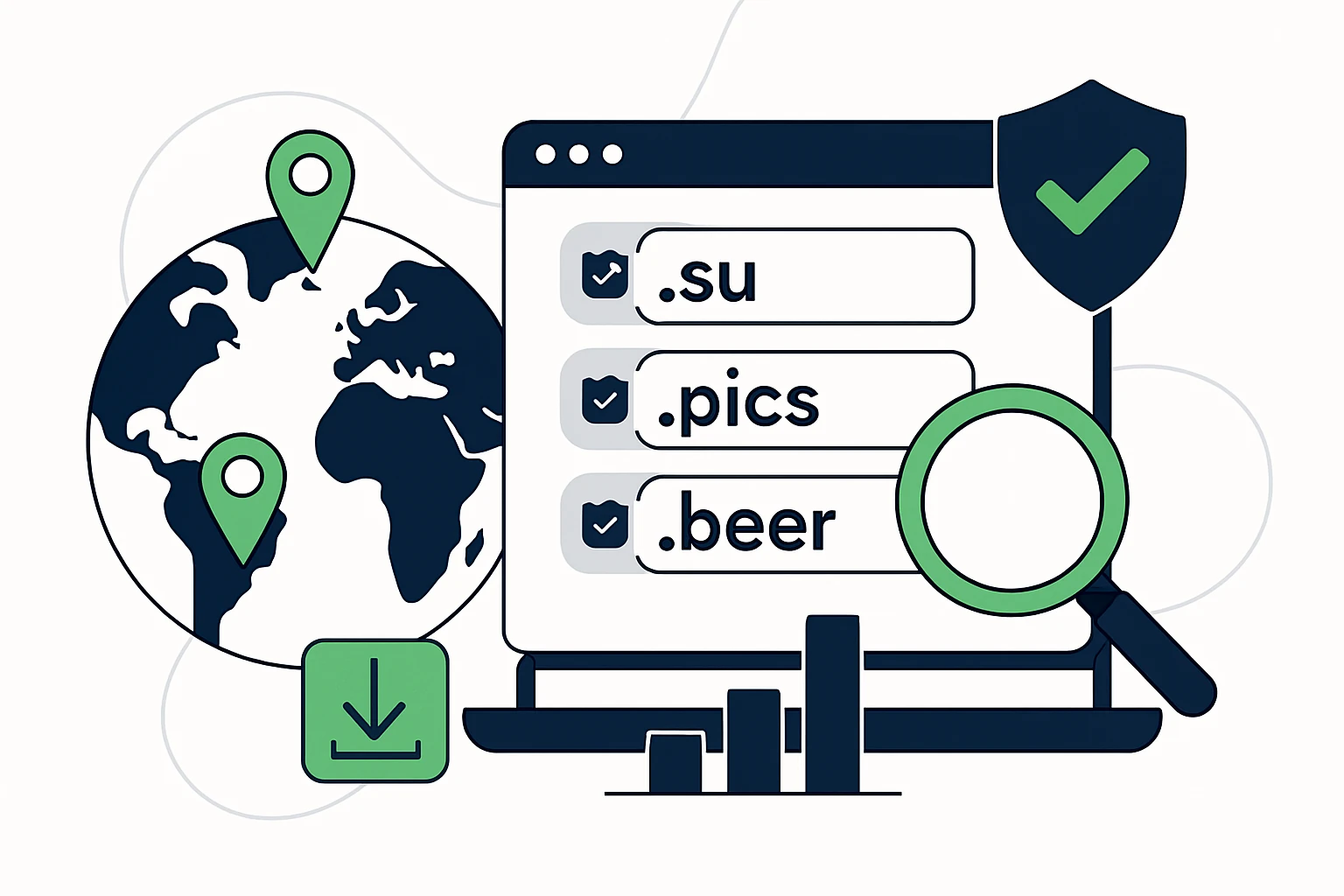
.su is a legacy TLD tied to the former Soviet Union. It remains active and delegated, maintained within the Root Zone Database, which is the official registry reference for all TLDs. For brand protectors, that means a nontrivial, enduring surface to monitor, even if its adoption rate is far below that of mainstream gTLDs. The Root Zone Database lists .su and its administrative context among the world’s delegated TLDs, confirming its continued operational status. Root Zone Database (IANA).
.pics and .beer are examples of newer generic TLDs designed to convey specific meaning (imagery and beverages, respectively). While newer gTLDs offer branding opportunities, they also attract opportunistic actors who perform typosquatting or rapid domain churn to harvest traffic or host phishing pages. APWG’s quarterly analyses consistently show that phishing domains are distributed across a broad spectrum of TLDs, including generic and newer gTLDs, underscoring the need to monitor beyond the traditional .com/.net/.org space. APWG Phishing Activity Trends Report Q4 2024.
How to source and responsibly use niche TLD domain lists
To operationalize niche TLD monitoring, security teams should combine authoritative registries with practical data procurement that suits their risk appetite. For practitioners seeking concrete lists by TLD, data providers and research portals often curate batch downloads that can be ingested into threat intel tooling. The client data partner WebAtla provides a set of official, publicly accessible pages that enumerate domains by TLD, including niche spaces such as .su, and offers a workflow for extracting, normalizing, and enriching these lists for security use. For example, you can directly access the niche .su domain list here: download list of .su domains. If you want an overview of multiple TLDs, the general List of domains by TLDs page is a useful starting point. For rapid validation and enrichment, the platform also hosts an RDAP/WHOIS database interface that security teams can consult as part of a verification workflow: RDAP & WHOIS database.
Structured framework: selecting, validating, and acting on niche TLD lists
| TLD | ||
|---|---|---|
| .su | Legacy usage, potential for impersonation of regional brands, slow phishing domain churn | Cross-check with brand keywords, add to watchlist, verify registrant data via RDAP/WHOIS, monitor for credential-phishing landing pages |
| .pics | Brand- or image-related domain schemes, typosquatting around image-heavy campaigns | Filter by brand imagery terms, deploy automated detection for homographs and brand-relevant terms, regular scrapes of new registrations |
| .beer | Industry-specific domains used for events or counterfeit product pages | Track campaigns tied to beverage brands, analyze landing pages for counterfeit product claims, and flag impersonation risks |
Operational monitoring workflow: from list to action
Effective monitoring weaves together data acquisition, enrichment, detection, and response. The following workflow keeps niche TLD monitoring grounded in practice:
- Ingest and normalize: Regularly pull domain lists from trusted sources (e.g., niche TLD pages such as .su, broader TLD catalogs) and normalize domain formats for consistent processing. The example lists from download list of .su domains and List of domains by TLDs offer a structured starting point.
- Enrich with threat context: Append WHOIS/RDAP data, registration dates, and DNS history to identify suspicious registration timing, privacy-wrapped registrants, or rapid changes - typical indicators of opportunistic abuse. See RDAP/WoHIS resources for cross-validation: RDAP & WHOIS database.
- Assess risk context: Score domains by brand relevance, visual similarity, and historical abuse signals (phishing pages, counterfeit content, or malware redirects). Use a risk scoring framework that weighs immediacy (recent registrations) and potential impact (brand impersonation in key markets).
- Detect and alert: Implement automated checks that flag domains with suspicious registrant data, typosquatting cues, or active phishing pages. Tie alerts to incident response workflows so teams can triage quickly.
- Respond: For confirmed abuse, coordinate takedown requests with registries, notify stakeholders, and preserve evidence for post-incident reviews. This is where structured data and logs from niche TLD monitors feed into your broader security operations playbooks.
Expert insight and common limitations
Expert insight: Industry experts emphasize that niche TLD monitoring should be part of an integrated risk program, not a standalone hobby. A disciplined approach pairs niche TLD lists with broader threat intelligence and brand-monitoring capabilities to improve signal quality and reduce false positives. Contextual enrichment - registrant, DNS history, and hosting information - is essential to separate legitimate registrations from potential abuse.
While the approach above is useful, it is not a panacea. Limitations and common mistakes include treating every niche TLD domain as malicious, relying on stale lists, or attempting to act on every alert without triage. Phishing activity remains a moving target: attackers continuously adapt, and threat actors increasingly blend domain abuse with other vectors, such as social engineering or AI-assisted campaigns. APWG’s quarterly reports repeatedly show that phishing activity persists across vectors and TLDs, underscoring the need for ongoing validation and process improvement. APWG Phishing Activity Trends Report Q4 2024, Verizon DBIR (phishing context).
Limitations and common mistakes in niche TLD monitoring
Limitations abound when focusing on niche TLDs. Lists can become stale, and not every registered domain within a niche TLD is malicious. Some may be legitimate brands experimenting with new marketing tactics or regional campaigns. A common mistake is over-indexing on a single data source or overreacting to a single questionable registration without corroborating signals such as hosting patterns, landing page content, or known phishing indicators. A balanced approach uses niche TLD lists as a starting point within a layered threat model, combining them with broader domain intelligence, DNS telemetry, and user-report data to validate risk before taking action.
Conclusion: turning niche TLD data into actionable brand protection
Monitoring niche TLDs such as .su, .pics, and .beer is not a luxury, it is a practical extension of a modern brand protection program. By systematically downloading and enriching niche TLD domain lists, applying a transparent risk framework, and aligning alerts with incident response workflows, security teams can reduce impersonation risk, catch phishing attempts earlier, and protect brand integrity across global markets. As phishing continues to evolve, a disciplined, data-driven approach to niche TLD monitoring - integrated with your existing threat intelligence and brand protection tools - becomes a key differentiator in digital risk defense. For teams seeking scalable access to domain lists and enrichment, consider integrating official data sources (such as your chosen TLD catalogs) with RDAP/WHOIS lookups to ground decisions in verifiable registration information.
For practitioners who want to explore the data landscape, the client data hub provides a gateway to niche domain lists and related infrastructure: download list of .su domains, List of domains by TLDs, and RDAP & WHOIS database.