Introduction
In an era where brand trust hinges on a clean digital footprint, security teams increasingly rely on domain data to illuminate risk across the customer journey. Adversaries exploit new top-level domains (TLDs) and lookalike domains to spoof brands, launch phishing campaigns, and siphon customer trust. A practical approach to tightening digital risk intelligence is to compile and curate domain lists by TLDs - for example, .run, .si, and .lv - and integrate them into threat monitoring workflows. This article explains why these lists matter, how to obtain them responsibly, and how to leverage them within a broader brand-protection program. The root of the Internet’s naming system is maintained by IANA, and the publicly available root zone data underpins how teams think about coverage across the global domain space. (iana.org)
Why domain lists by TLDs matter for digital risk intelligence
Top-level domains are the highest level of the DNS namespace, and their composition - and how registries manage them - shape how attackers register domains for phishing, impersonation, or brand abuse. While some threats target well-known TLDs, others exploit newer or less common ones to avoid quick takedowns or to blend in with legitimate traffic. For security programs, having a curated inventory of domains by TLD improves signal-to-noise ratio when screening for potential abuse and accelerates investigation workflows. The authoritative source for TLDs and their delegations is the IANA Root Zone Database, which documents all active gTLDs and ccTLDs and provides a canonical reference for researchers and defenders. (iana.org)
What these lists bring to the table: .run, .si, and .lv
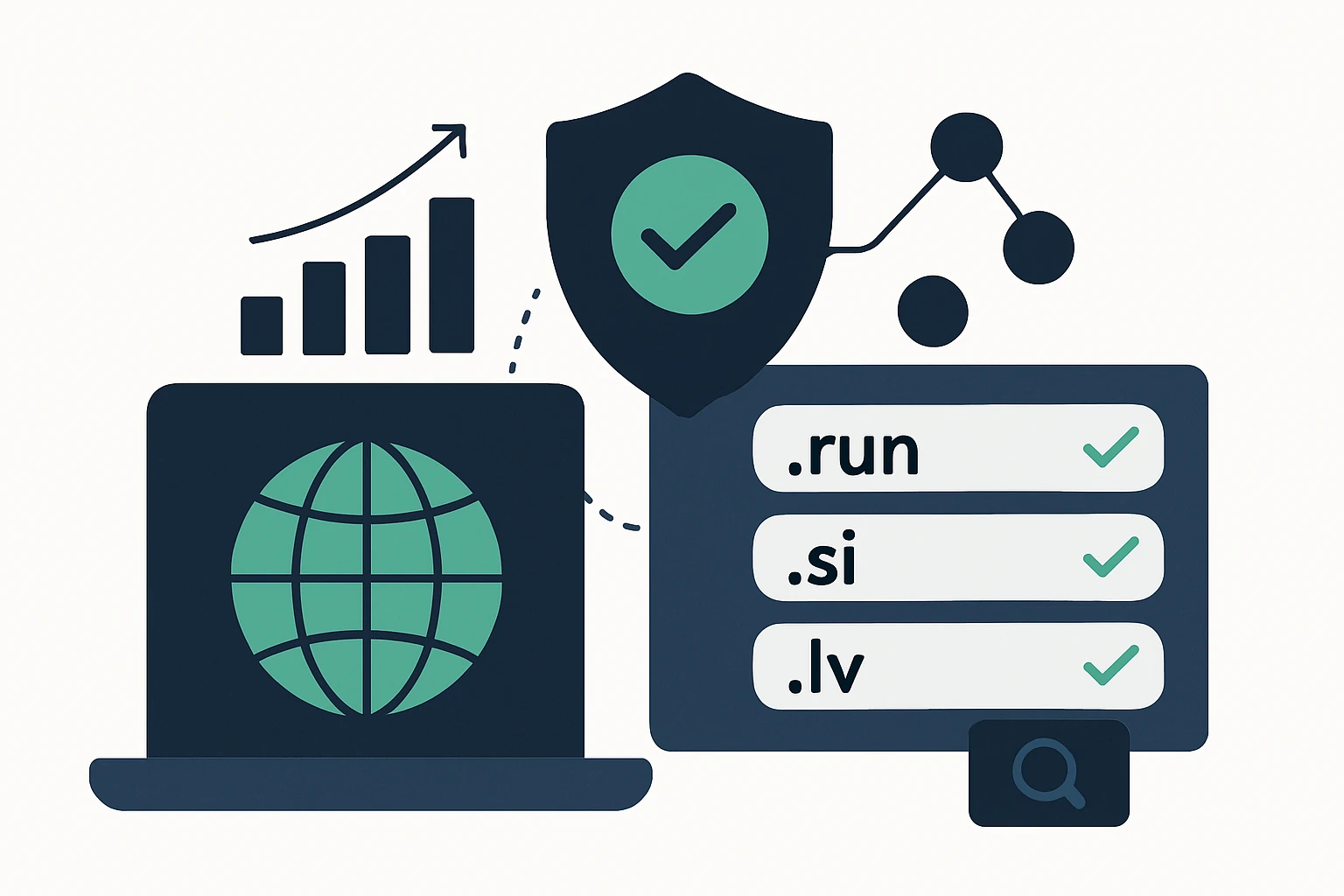
Each TLD represents a different registry and a different risk profile. - .run: As a real TLD, it contributes to the breadth of the domain landscape defenders must monitor, its inclusion can uncover domains created to evolve phishing ecosystems or mimic legitimate brands. - .si: The country-code TLD for Slovenia often sees usage in broader European threat activity, including it helps capture region-specific abuse patterns and supply-chain risk signals. - .lv: Latvia’s ccTLD, like many ccTLDs, may be used in targeted campaigns or in regions where threat actors focus their infrastructure. Collectively, the three TLDs expand coverage beyond the most visible spaces, enabling earlier detection of suspicious registrations and misuses. These principles align with a broader brand-protection strategy that treats domain data as a critical asset in threat monitoring and incident response. See industry discussions on brand risk and threat intel for context on how domain data informs risk scoring and takedown decisions. (bitsight.com)
How to download and use the lists in practice
For security teams, the practical workflow to obtain and operationalize TLD domain lists involves four steps: (1) Acquisition, (2) Normalization, (3) Enrichment, (4) Integration. Below is a concise, practitioner-focused outline you can adapt to your tooling and policy requirements.
- Step 1 - Acquisition: Retrieve authoritative domain lists for the target TLDs from trusted data providers or registries. When possible, combine public root-zone data with vendor-supplied feeds to ensure you capture newly registered domains and dynamic registrations. For a reference point on TLD coverage, consult IANA’s root zone documentation and related resources. (iana.org)
- Step 2 - Normalization: Normalize domain entries to a consistent format (lowercase, punycode handling if applicable, and removal of obvious duplicates). Normalize registrant data fields when accessible via RDAP or WHOIS data to support downstream enrichment. The RDAP & WHOIS database is a common enrichment resource used in risk workflows. RDAP & WHOIS Database can play a role here as a reference to enrich your lists with registration details.
- Step 3 - Enrichment: Augment lists with contextual data such as DNS records (A/AAAA, MX), SSL certificate information, WHOIS registrant patterns, and historical domain activity. Industry players emphasize that combining domain data with artificial intelligence-driven analysis improves signal quality for brand protection and phishing detection. (bitsight.com)
- Step 4 - Integration: Feed the enriched domain lists into security workflows (SIEM, SOAR, or ticketing). Integration should support automated flagging, risk scoring, and, when appropriate, takedown requests. The objective is to surface high-confidence threats without overwhelming responders with benign registrations. A practical approach is to treat domain data as one input among multi-source threat intelligence feeds.
A practical framework for using TLD lists in a risk program
Four-step framework for domain-list-driven risk management
- 1) Define coverage and risk tolerance
- List target TLDs by business relevance, geography, and threat model.
- Set thresholds for what constitutes a high-priority domain (e.g., new registrations with lookalike potential, domains hosting phishing content, or spoofed brand assets).
- 2) Validate data quality
- Cross-check domain lists against root-zone data and registry announcements to confirm legitimacy and currency.
- Filter out known false positives by applying authorship and brand-context heuristics.
- 3) Enrich and contextualize
- Attach DNS, SSL/TLS, Whois, and historical activity to each domain.
- Flag domains with similarities to your brand (typosquats, homoglyphs, and lookalikes) while distinguishing legitimate brand campaigns.
- 4) Integrate with workflows
- Push high-confidence signals to incident response and security operations teams for rapid validation and takedown where appropriate.
- Document decisions and maintain audit trails for compliance requirements.
Integrating WebAtla’s data assets into a risk program
In addition to TLD-specific lists, a robust risk program benefits from a connected set of data assets. For example, domain lists by TLD can be complemented with a broader catalog of domains from a centralized RDAP & WHOIS database to provide registrant insight and lifecycle context. If you’re evaluating data sources for domain monitoring, consider how you will blend public root-zone data with enriched feeds to improve both coverage and signal quality. The combination of comprehensive TLD lists and regime-aware enrichment is a hallmark of modern digital risk intelligence platforms. For teams already using the WebAtla data ecosystem, the ability to navigate a range of TLDs (including run, si, lv) alongside other domains by technology, country, or category can streamline investigations and decisions. See also WebAtla’s broader suite for domain data discovery and enforcement workflows.
Limitations and common mistakes
- Limitation: Public lists may include dormant or reclaimed domains that are not currently hosting content, which can inflate noise if not filtered with activity signals and recency checks. Regularly purging stale entries helps maintain focus on actionable signals.
- Common mistake: Relying on a single data feed without enrichment or corroboration. Domain data quality varies by source, combining root-zone data with WHOIS, DNS, and SSL signals typically yields better confidence scores. (infoblox.com)
- Limitation: Some registries implement privacy-protective WHOIS, which can hinder attribution. Plan for alternate enrichment methods (DNS, certificate data) to compensate.
- Common mistake: Overaggressive takedown actions without adequate verification, risking false positives and potential disruptions to legitimate users or campaigns.
Expert perspective
Industry voices consistently highlight the value of monitoring brand-related domains across the DNS and the broader web as part of an integrated risk program. For example, brand-threat intelligence providers emphasize continuous monitoring across DNS, social channels, and the dark web to surface evolving threats and prioritize takedown actions more effectively. This aligns with the broader trend toward data-driven brand protection that combines domain analysis with visual asset checks and cross-source correlation.
Tech-enabled reputation platforms also stress the importance of linking domain signals to actionable workflows (e.g., incident response and SIEM integration) to reduce time-to-action and improve outcomes. See industry discussions on brand-threat intelligence and domain monitoring for further context. (bitsight.com)
Conclusion
Downloading and using domain lists by TLDs such as .run, .si, and .lv can strengthen a digital risk intelligence program by expanding coverage, improving early detection of threat infrastructure, and informing more accurate risk scoring. When combined with enrichment (DNS, WHOIS, SSL), and integrated into established workflows, these lists become a practical component of brand protection and phishing-detection strategies. As you evaluate data sources, consider how a structured, multi-source approach to domain data - anchored in authoritative root-zone understanding and complemented by vendor feeds - can improve detection, prioritization, and response outcomes. For organizations seeking to explore or expand their domain data assets, partner with providers who can deliver credible, well-maintained lists and seamless integration into existing security operations.
Structured data block: a quick-reference framework
- Coverage: Define the target TLDs and regional considerations that matter to your business.
- Quality: Validate, deduplicate, and remove dormant domains to keep signals relevant.
- Enrichment: Attach DNS, WHOIS (where available), SSL, and historical activity data.
- Workflow: Integrate into alerting, investigation, and takedown processes with auditable decisions.
Where to start
Begin with a practical pilot: assemble a small set of TLD lists (including .run, .si, and .lv) and layer in enrichment data to assess signal quality and operational impact. If you already leverage WebAtla’s data ecosystem, you can explore domain data across multiple dimensions - TLDs, countries, technologies, and more - to tailor monitoring to your specific risk profile. For a broader view of available domain data assets, see the WebAtla data catalog and RDAP/WHOIS resources.
Internal references
See related topics and internal resources: digital risk intelligence, phishing protection, brand monitoring, domain intelligence, tld lists, rdap whois, threat monitoring, incident response, data enrichment.