From WHOIS to RDAP: The Data Backbone of Digital Risk Intelligence
Digital risk intelligence (DRI) is the discipline of collecting, correlating, and acting on online signals that can threaten a brand’s safety, reputation, and economic value. A modern DRI program relies as much on the quality of the data as on the analytics that process it. In practice, that data backbone is increasingly shaped by the Registration Data Access Protocol (RDAP), the standardized, machine-readable successor to the long-dominant WHOIS system. As of January 28, 2025, ICANN has positioned RDAP as the definitive source for generic top-level domain (gTLD) registration data, marking a permanent transition away from legacy WHOIS in many registries. This shift is not just a technology footnote, it has real consequences for threat monitoring, incident response, and brand protection workflows. ICANN’s official update on RDAP sunset and the RDAP specifications from the IETF formalize why RDAP matters: structured data, standardized fields, and better support for automation. For security teams, this means easier integration into dashboards, faster enrichment of signals, and clearer provenance for each domain record. ICANN’s RDAP ecosystem provides concrete lookup endpoints and community resources to operationalize RDAP data across platforms.
Expert insight: Domain data quality is the single most important driver of accurate threat detection in a modern digital risk program. Without reliable, machine-readable domain data, even the best analytics will generate false positives or misses.
The practical takeaway is simple: as RDAP replaces WHOIS for core domain registration data, security teams should align their data pipelines, alerting rules, and incident workflows with RDAP endpoints and standardized fields. This alignment reduces ambiguity when triaging phishing sites, fraudulent registrations, or impersonation efforts that span multiple countries and languages. The result is a more repeatable, auditable, and scalable approach to digital risk management.
Country-Level Domain Data: Why Geography Matters in Threat Monitoring
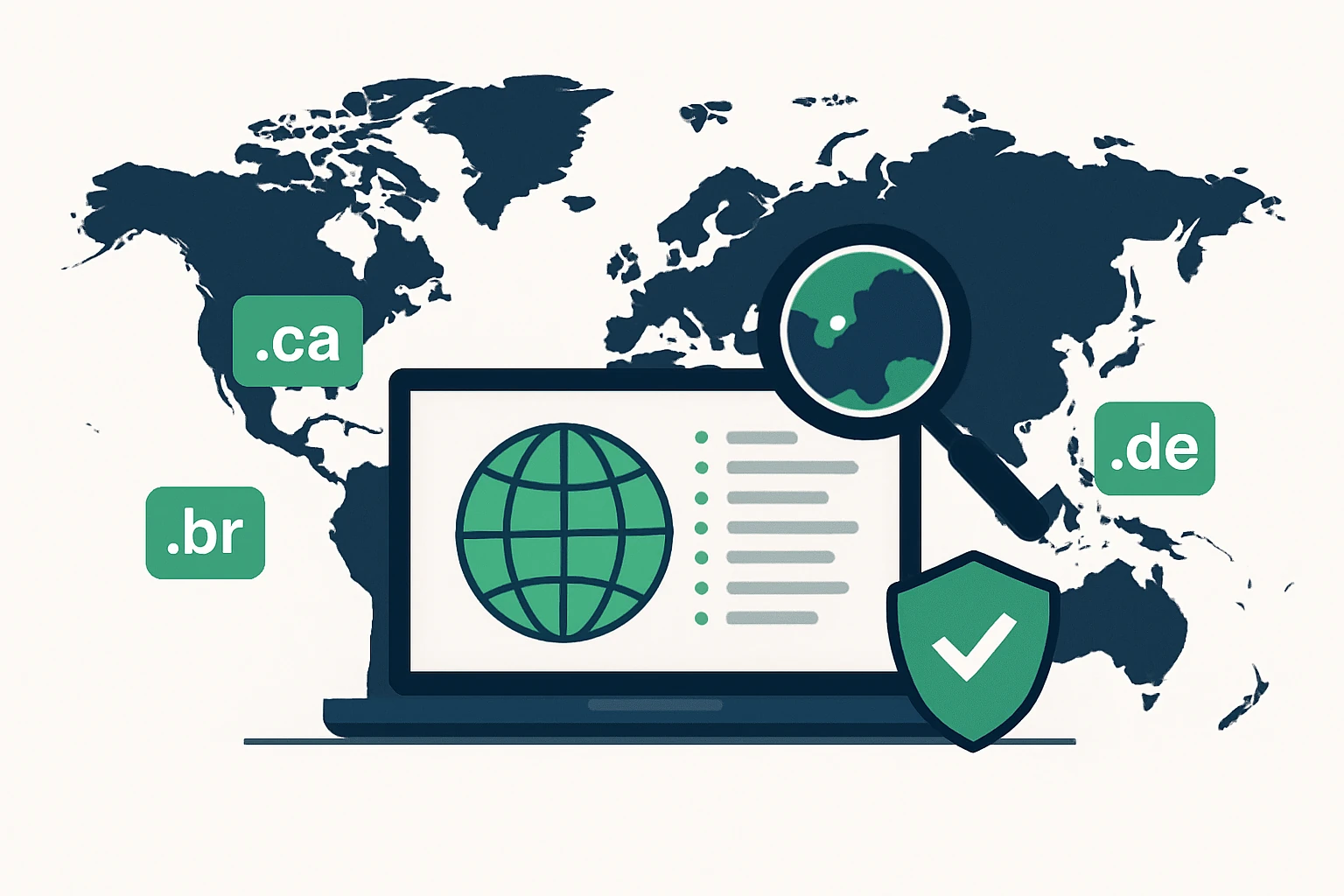
Threat actors operate across borders, selecting country-specific strategies to maximize impact or evade takedowns. A robust domain intelligence program must therefore go beyond a single TLD and embrace a country-aware view of the internet’s domain surface. A website database by country - often comprising country-code TLDs (ccTLDs) and relevant gTLDs - enables teams to map the true footprint of a brand’s online presence. It also uncovers regional variants, typosquatting attempts, and lookalike domains that are designed to exploit local languages, regulatory environments, or consumer trust signals.
Why this matters in practice:
- Asset visibility: A country-focused catalog helps security teams inventory legitimate assets (regional microsites, local brand pages, or region-specific campaigns) and identify gaps where a counterfeit site could emerge.
- Threat hunting efficiency: Prioritized monitoring across geographies reduces the time spent chasing irrelevant signals and accelerates takedown decisions when a threat appears in a high-risk region.
- Localized risk signals: Some phishing schemes tailor their lure to specific markets (language, payment methods, or regulatory references). A country-aware view makes it easier to recognize and respond to these localized nuances.
For organizations with global brands, pairing country-domain data with global risk intelligence creates a layered view: you see both the broad surface and the regional hotspots where impersonation or fraud is most likely to occur. This approach is particularly effective when combined with RDAP-based enrichment, which provides consistent ownership and registration details across jurisdictions.
Phishing Protection and Brand Monitoring: Leveraging Domain Intelligence
Phishing protection and brand monitoring rely on a multi-faceted view of the domain landscape. Domain intelligence helps identify lookalike domains, typosquats, and knockoffs that could be used to deceive customers or dilute brand value. Traditional monitoring that focuses solely on brand keywords risks missing subtle or novel impersonation schemes - such as generated squatting domains or homograph domains that visually resemble the real brand in non-Latin scripts. A domain-centric approach complements visual and textual monitoring by providing concrete ownership data, hosting details, and registration histories that support takedown requests and enforcement actions.
In practice, teams combine several capabilities to strengthen phishing protection and brand integrity:
- Continuous domain surveillance across core TLDs and relevant ccTLDs to detect new registrations that resemble the brand.
- Automated enrichment using RDAP data to verify registrant organization, creation date, and nameserver configurations.
- Early warning signals for high-risk variants (typos, altered spellings, or lookalike brand terms) and rapid triage workflows for security operations.
These capabilities are complementary to user education, email authentication, and endpoint security. A mature program treats domain intelligence as a strategic input to risk scoring, incident response, and brand enforcement, rather than a one-off alerting tool. For teams seeking deeper access to domain data, documented RDAP lookup endpoints and related resources provide the foundation for scalable search and enrichment pipelines.
Structured Framework: A Practical 5-Step Domain Intelligence Approach
To operationalize domain intelligence within a digital risk program, use this compact framework. It’s designed to be implemented incrementally, with room for automation and human review as your team’s capabilities grow.
- Survey: Build a comprehensive catalog of assets by country, including official brand sites, regional portals, and authorized resellers. Map the discovery scope to your risk tolerance and regulatory considerations.
- Compare: Align discovered domains with known legitimate assets. Use RDAP enrichment to confirm ownership and hosting details, and identify high-risk variants (typosquats, lookalikes, or spoofed subdomains).
- Alert: Establish risk-based alerts for new registrations that resemble the brand, changes in registrant data, or suspicious hosting patterns. Prioritize alerts by geography, brand-critical products, or customer impact.
- Notify: Integrate with incident response workflows and takedown processes. Prepare evidence packages (registration data, hosting history, and screenshots) to support enforcement or deprecation actions.
- Nurture: Iterate the program by reviewing false positives, refining detection rules, and expanding country coverage. Maintain ongoing enrichment to reduce the gap between discovery and remediation.
This framework foregrounds data quality, process discipline, and cross-functional collaboration - key drivers of durable brand protection and fraud detection outcomes. The RDAP-centric data layer supports automation and auditability, which are essential when your organization must demonstrate due diligence to partners, regulators, or internal risk committees.
Limitations, Trade-offs, and Common Mistakes
Every approach to domain intelligence comes with trade-offs. Recognizing them upfront helps teams design more effective security programs and avoid common missteps.
- Data availability and latency: Not all TLDs uniformly support RDAP yet, and some regions may lag in data completeness. Plan for phased coverage and maintain fallback workflows for non-RDAP data.
- Data quality and inconsistency: Even with RDAP, data quality can vary across registries. Cross-check critical fields (ownership, contact information, and registrant status) against multiple sources when possible.
- False positives and alert fatigue: Broad surveillance across many geographies will create more alerts. Calibrate thresholds by asset criticality and historical incident patterns to keep triage sustainable.
- Takedown complexity: Enforcement varies by jurisdiction and platform. Legal processes, local policies, and platform-specific posting rules influence how quickly a threat can be neutralized.
- Privacy and data minimization: As data becomes more machine-readable, ensure your usage complies with privacy regulations and internal data-handling standards. RDAP’s structured data helps automate risk scoring, but it also requires careful governance.
Common mistakes include treating domain data as a silver bullet, under-investing in enrichment, or relying on a single data source. A robust program blends domain intelligence with other signals - email authentication results, hosting risk indicators, and customer-facing threat intelligence - to produce a well-rounded risk picture.
Real-World Application: How a Global Brand Can Operationalize Domain Intelligence
Consider a multinational consumer brand with official sites in North America, Europe, and Asia. The company maintains a country-domain directory to monitor ccTLDs and select gTLDs known to be favored by threat actors targeting those regions. The security team integrates RDAP-enriched domain data into a centralized risk dashboard. When a new domain appears that resembles the brand in a high-risk market (for example, a near‑duplicate spelling or a visually similar logo term used in a local language), the system automatically flags it as a high-priority incident and generates an evidence bundle with ownership details, DNS history, and hosting information. The brand can then initiate takedown actions, coordinate with local legal teams, and, if appropriate, refer customers to the official site instead of the counterfeit page.
For teams seeking to scale this capability, WebAtla’s RDAP &, WHOIS database and country-domain directory provide practical data sources to support the framework. These resources offer centralized access to registration data and country-specific domain landscapes, helping brands maintain a consistent, auditable approach across regions. For organizations exploring these capabilities, see RDAP &, WHOIS database and the list of domains by country to start building a country-aware risk profile.
Conclusion: A Proactive, Geography-Sensitive Domain Strategy for Digital Risk
Digital risk intelligence is most effective when it sits on a solid data foundation, a clear geography strategy, and disciplined workflows for detection, triage, and enforcement. The shift to RDAP provides a modern, machine-readable data backbone that makes domain intelligence more actionable, auditable, and scalable. By coupling country-level domain data with RDAP-enriched signals, security teams gain sharper visibility into their global footprint and more precise indicators of risk. The result is stronger phishing protection, more reliable brand monitoring, and a more proactive fraud detection capability - across all geographies that matter to your business.
As you evolve your program, remember that RDAP is not just a data feed - it’s a foundation for integrated risk strategies. Organizations that treat domain data as a strategic lever - supported by reliable country-domain catalogs and robust enrichment - will be better positioned to protect their brands, customers, and bottom line in an increasingly complex digital ecosystem.