Introduction: Why bulk domain lists matter for digital risk intelligence
Digital risk intelligence and brand protection rely on more than watching for obvious brand abuse. Large, regularly updated lists of registered domains enable security teams to spot lookalike domains, typosquats, and other fraudulent registrations that threaten a brand’s trust and customers. But raw lists are just the starting point: they must be obtained legally, refreshed consistently, and enriched with context to drive action. In practice, successful programs combine zone-file data with threat signals, risk scoring, and operational playbooks to turn data into measurable protection against phishing campaigns, brand hijacking, and fraud attempts.
Industry trends confirm the scale of the challenge. The FBI’s Internet Crime Center (IC3) highlights phishing and spoofing as top categories of reported cybercrimes, underscoring why organizations must monitor broad domain space in near real time. At the same time, European and global threat landscapes emphasize phishing alongside ransomware and data breaches as ongoing risks that demand resilient monitoring and intelligent triage. IC3’s 2024 report and the latest ENISA threat landscape both reinforce that proactive domain monitoring is a core element of modern cyber risk management. (ic3.gov)
Where bulk domain data comes from and what you can access
Bulk domain data most commonly originates from DNS zone files - the authoritative lists of domains registered under a top-level domain (TLD). Access to these files is typically controlled and requires a formal process. The ICANN Centralized Zone Data Service (CZDS) provides a centralized portal for approved organizations to request and download zone files from participating registries, enabling researchers, security teams, and risk providers to bulk-download domain data for legitimate purposes. You’ll find the official description and access mechanism here: ICANN Centralized Zone Data Service (CZDS). (czds.icann.org)
Once access is granted, you can obtain zone-file data via the CZDS or, for certain registries, via direct registry channels. Verisign’s guidance notes that CZDS is the route to obtain the .com, .net, and other Verisign-managed gTLD zone files, with ongoing documentation on how to request and receive the data. This centralized mechanism is designed to simplify the procurement and distribution of zone data across organizations. Verisign Zone File Information. (verisign.com)
In practice, the workflow often starts with a CZDS application, followed by registry-specific access steps. The CZDS naming and user-guides explain how registries publish zone data and how end users can download and ingest it. For those who want a practical, developer-friendly view of the process, community resources and code samples exist to help automate downloads once access is granted. CZDS Access Guide. (icann.org)
Why .eu, .site, and .co matter for risk intelligence and brand protection
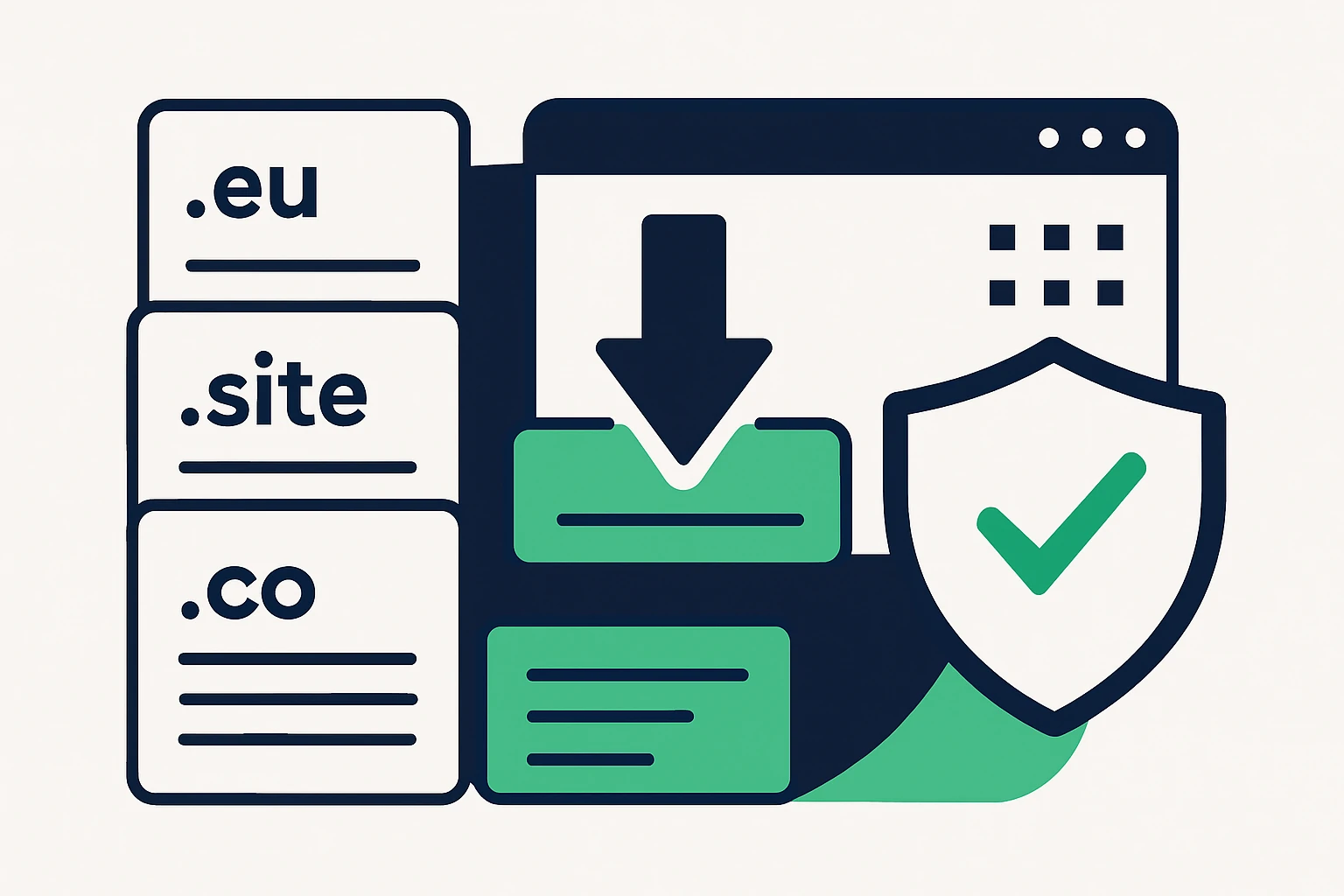
Different TLDs reflect different risk profiles and brand exposure. .eu domains are subject to European regulatory and market dynamics, while .site and the Colombia-based .co have distinct registration patterns and use cases. For threat investigators and brand protectors, monitoring these domains helps surface typosquats, lookalikes, and high-risk registrations that could mislead customers or siphon brand value. While zone files provide a comprehensive baseline list of registered domains, the true value comes when you enrich this data with context, such as registration dates, registrant patterns, and threat signals from threat intelligence feeds.
To support this layered approach, organizations commonly pair zone-file data with Whois/RDAP data, abuse reports, and phishing indicators to distinguish legitimate registrations from malicious activity. The RDAP and Whois data you access through reputable databases can help you validate registrant legitimacy, transfer status, and hosting patterns. For example, access and usage of RDAP/WoHIS data are a common component of risk platforms that aim to verify domain ownership and registration activity, often via providers like WebAtla’s RDAP & WHOIS databases. WebAtla: RDAP & WHOIS Database. (verisign.com)
Practical workflow: acquiring, validating, enriching, and acting on bulk domain data
Below is a practical, risk-aware workflow for turning bulk domain lists into actionable protections. It emphasizes legality, data quality, and integration with brand risk programs. The steps are designed to be adaptable to different TLDs (including .eu, .site, and .co) and to work alongside a broader threat-intelligence stack.
1) Acquire zone-file data through legitimate channels
Begin with a formal access request via CZDS to obtain zone files for the target TLDs. The CZDS platform is the centralized gateway, and registries may require additional forms or verification. Documentation and user guides outline the process and expectations for ethical use. ICANN CZDS and CZDS overview provide the authoritative background. (czds.icann.org)
2) Normalize, deduplicate, and normalize domain formats
Zone files deliver a comprehensive set of registered domain names, but you must harmonize formats across sources, handle case normalization, punycode, and subdomain boundaries, and deduplicate across multiple TLDs. A clean, consistent base dataset reduces false positives when you begin to compare against alert feeds and brand-abuse signals. Real-world implementations often include scripting layers that standardize domain representation before enrichment.
3) Enrich with risk signals and contextual data
Pure zone lists tell you what exists, enrichment adds meaning. Layer on threat signals such as historical abuse reports, phishing indicators, and brand-abuse trends. European and global threat intelligence work shows phishing as a dominant attack vector, reinforcing why enrichment improves detection quality rather than relying on raw registration data alone. See ENISA’s Threat Landscape and IC3’s annual reports for context on the scale and variability of phishing and related threats. ENISA Threat Landscape 2025 and IC3 2024 Annual Report. (enisa.europa.eu)
4) Operationalize with monitoring, alerts, and response playbooks
Turn enriched domain data into defense-ready intelligence by integrating with brand-monitoring workflows, phishing-detection rules, and incident response playbooks. A well-tuned system flags high-risk registrations (e.g., domains with near-identical spellings, rapid registration bursts around product launches, or regions with higher abuse activity) and routes them to analysts or automated remediation processes. This is where a digital risk platform that combines zone data with threat signals and RDAP/Whois context adds measurable value. For organizations seeking a structured stance, reputable risk platforms advocate layering data and automating triage to avoid alert fatigue.
For teams that want a readily searchable supply of domain data and registrant details, consider how WebAtla’s capabilities can complement your workflow: RDAP & WHOIS database for validation, and EU-domain lists or tld-based domain lists as reference data you can cross-check against. These resources help you build robust, defensible risk signals without sacrificing speed. (verisign.com)
A practical framework you can reuse (a structured block)
-
1) Acquire
Obtain zone-file data through CZDS or registry channels for the TLDs you monitor, ensure compliance with terms and use-case requirements.
-
2) Normalize
Standardize domain formats across sources, fix casing, de-duplicate, and resolve any ambiguous entries to a clean, actionable list.
-
3) Enrich
Attach risk scores, abuse histories, and Whois/RDAP context to each domain to distinguish legitimate registrations from suspicious activity.
-
4) Act
Integrate with brand-protection workflows, set alerts, and automate containment (e.g., takedown requests, domain blocks) where policy and law permit.
Limitations, trade-offs, and common mistakes
-
Limitation: zone files are a registry-owned snapshot
Zone files reveal registered domains but not hosting behavior, intent, or traffic. Complementary data (e.g., hosting indicators, phishing reports) is essential to avoid misclassifying legitimate registrations as threats. ICANN’s CZDS framework explains that access is controlled and intended for legitimate use, not broad, unauthorized scraping. CZDS overview. (czds.icann.org)
-
Trade-off: access vs. freshness
Zone-file data typically reflects a snapshot and is not always real-time. Daily or near-daily refreshes via CZDS mitigate this, but some registries may lag or require additional steps to obtain updates. For up-to-date risk signals, pair zone data with live threat intel feeds.
-
Common mistake: treating lists as a one-size-fits-all signal
Bulk domain lists are a starting point. Without enrichment and contextual scoring, teams risk chasing false positives or missing high-risk patterns that emerge only when signals are correlated across sources. ENISA’s threat data and FBI IC3 findings consistently show phishing as a dynamic, adaptive threat requiring layered defenses. ENISA Threat Landscape 2025, IC3 2024 Annual Report. (enisa.europa.eu)
Evidence and credible sources you can rely on
For readers who want to understand the broader threat context behind bulk-domain monitoring, a few high-level sources are especially relevant. IC3’s annual reports consistently show phishing as a leading category of complaints and losses, highlighting the ongoing need for proactive domain monitoring as part of risk programs. 2024 IC3 Annual Report provides detailed statistics and trends. Additionally, ENISA’s Threat Landscape 2025 outlines the eight prime threat types and emphasizes phishing and social engineering as central challenges in the EU and globally. ENISA Threat Landscape 2025. (ic3.gov)
Conclusion: turning bulk domain data into defensible action
Bulk domain lists, such as those for .eu, .site, and .co, provide an essential foundation for digital risk intelligence and brand protection. The real value lies in legally acquiring the data, cleaning and enriching it with context, and operationalizing it within a risk program that includes alerting and incident response. By combining CZDS-based zone data with Whois/RDAP context and threat signals, security teams can detect and disrupt phishing campaigns and brand-abuse attempts more quickly and with less noise. For organizations seeking practical tooling to support these efforts, consider integrating zone-file data with a robust threat-intelligence workflow and, where appropriate, leveraging specialized data services such as WebAtla’s RDAP & WHOIS database and domain lists by TLDs to supplement your internal datasets. RDAP & WHOIS Database • EU domain lists • TLD-based domain lists. (verisign.com)