Domain Lists for Digital Risk Intelligence: .ie, .il, and .one in Brand Protection
Digital risk intelligence is about more than fortifying a single gateway. It requires scanning the external digital surface for signals that could threaten a brand, its customers, and its reputation. One practical data source that often travels from the research desk to operational playbooks is a domain list - structured inventories of registered domains, sometimes segmented by top-level domain (TLD). When used thoughtfully, lists like those for .ie, .il, and .one can illuminate typosquatting, brand impersonation, and illegal use of a brand in new domains. But they are not a magic bullet. The value comes from how you acquire, validate, enrich, and act on those signals within a broader risk-management workflow. Framing domain lists as one signal among many is essential, and doing so requires a clear understanding of data quality, licensing, timeliness, and integration with other intelligence feeds. As a baseline, external threat intelligence platforms increasingly emphasize that raw domain data should be transformed into prioritized risk signals rather than treated as a final conclusion.
In practice, this means pairing list data with contemporary data streams and protocols for querying domain registration data. Registry operators and providers are moving toward standardized access, and modern threat work often hinges on machine-readable formats that can be integrated into automation pipelines. For example, the Registration Data Access Protocol (RDAP) is designed to replace legacy WHOIS with a consistent JSON model, making it easier to harmonize data from different sources and to automate decision-making. This standardization matters when you’re turning a raw list into a response playbook for brand protection or phishing defense. RDAP and related guidance are central to understanding how to operationalize domain data at scale. ARIN RDAP provides a concrete example of how RDAP is deployed across registries and registrars, underscoring the shift toward standardized query results that feed risk scoring and incident response workflows. ARIN RDAP (source: ARIN) and ICANN RDAP (source: ICANN) anchor the technical foundation for using domain data in defense programs.
Why domain lists matter for digital risk intelligence
At a high level, domain lists help security teams identify potential threat surfaces outside their immediate network perimeter. When monitored in near real time and enriched with registration data, historical context, and threat signals, these lists enable proactive responses to threats such as typosquatting, brand impersonation, and fraudulent domains used in phishing campaigns. Industry practice increasingly treats external domain data as a signal in a broader risk story - one that includes email security indicators, dark web monitoring, social media threat intel, and incident-response playbooks. In short, domain lists support early warning and faster containment, not solitary decision making. This perspective is widely reflected in modern digital risk protection approaches that emphasize monitoring, detection, and controlled disruption of phishing and brand abuse. Digital risk protection platforms describe a similar approach: surface signals, prioritize them, and automate where appropriate to block or disrupt malicious infrastructure before it harms customers.
Data reality: quality, timeliness, and coverage
Datasets that enumerate registered domains by TLD can provide a valuable signal, but their usefulness depends on several practical attributes. First, not all TLDs offer the same level of data access or public availability. Some registries expose RDAP endpoints, others rely on WHOIS or hybrid systems, and privacy redaction practices can obscure contact details. The ongoing transition toward RDAP - standardized data in JSON - helps teams harmonize information from multiple sources and feed automated workflows, but the transition also means that coverage can vary by registry. For instance, RDAP is becoming the standard in many regions, while a subset of TLDs still relies on legacy protocols or privacy-enabled disclosures. This reality underscores the importance of validating data freshness, completeness, and licensing before building risk-scoring models or automated takedown workflows. ICANN’s RDAP initiative and registries’ implementation guides emphasize the need for consistent, machine-readable access for modern risk programs. RDAP and the evolving data-access landscape provide the technical context for turning domain lists into actionable risk signals.
From a risk-management perspective, the practical takeaway is to treat domain lists as a component of an enriched data stack - one that combines registration data with threat intelligence signals, feed integrity checks, and compliance considerations. This perspective aligns with how major threat-intelligence platforms approach external data: not as standalone verdicts, but as inputs that feed risk scoring and response playbooks. For brand protection teams, this means domain lists can help surface potential threats, but should be paired with other signals to confirm risk and prioritize response.
Integrating domain lists into threat-intelligence workflows
Operational efficiency in digital risk protection relies on how well data is wired into workflows. The modern security stack benefits from structured, machine-readable signals that can be ingested into risk-scoring engines, anomaly detection pipelines, and incident-response playbooks. In practice, teams typically enrich domain lists with registration data (RDAP/WHOIS where available), WHOIS privacy considerations, and contextual signals such as known phishing infrastructure, brand-impersonation indicators, and reports from user or customer feedback channels. This approach supports more precise decisions - e.g., whether a newly observed domain is likely to be used for credential harvesting or misleading branding in a targeted campaign. The technical foundation for these integrations rests on standardized data-access protocols (RDAP) and consistent data models, which ICANN and registries are actively promoting. RDAP and related guidance are essential primitives for building scalable, defensible risk workflows. For practitioners seeking a concrete example of how RDAP data can be assembled into a unified database, organizations sometimes deploy consolidated registries that merge RDAP and legacy WHOIS data, offering a single, queryable view for security teams. ARIN RDAP is a practical reference for what unified, standards-based data looks like in production.
Use-cases: typosquatting, impersonation, and domain-based fraud signals
Three core use-cases demonstrate the value of domain lists in brand protection. First, typosquatting detection helps identify infringing domains that are visually or phonetically similar to a brand's own domain, capturing potential phishing or fraud attempts before they take root. Second, brand impersonation - where threat actors register domains designed to impersonate a brand in emails, apps, or websites - can be surfaced by monitoring newly registered domains within key TLDs and mapping them to known brand signals. Third, domain-based fraud signals - such as domains associated with known phishing infrastructure or compromised registrars - can be integrated with other intelligence feeds to drive faster containment actions. These use-cases align with the broader digital risk protection literature, which emphasizes early-warning and rapid takedown or disruption of malicious assets to reduce customer exposure and brand damage. Digital risk protection providers frequently frame this workflow as a continuous, end-to-end signal-to-action loop.
Limitations and common mistakes
- Data quality and scope: A public domain list may not cover every relevant TLD or niche registrar. Be mindful of gaps and verify coverage against internal inventory and other data sources.
- Timeliness: Domains register and disappear quickly. A list that is even a few days old can miss important developments. Combine domain lists with real-time registration data where possible via RDAP endpoints.
- Licensing and usage rights: Domain data often comes with specific licenses that constrain how it can be used, stored, and shared. Ensure compliance with terms to avoid legal and contractual risk.
- Privacy and redaction: Many RDAP/Whois outputs redact personal information, which can limit attribution and operational context. This is a feature of privacy regimes, but it also requires alternative signals to validate risk.
- Over-reliance on lists: Lists are signals, not verdicts. Treat them as one piece of a larger puzzle that includes phishing signals, email headers, and customer-reported abuse.
These caveats are widely discussed in the industry, where practitioners stress that external signals must be integrated with internal telemetry and risk scoring. The shift toward RDAP - while improving standardization - also requires teams to adapt their tooling and workflows to JSON-based data models and consider privacy considerations during deployment.
A practical framework for evaluating domain-list sources
- Define objective: Clarify whether the primary goal is phishing protection, brand monitoring, or fraud detection, or a combination of these use cases. This shapes data requirements and processing rules.
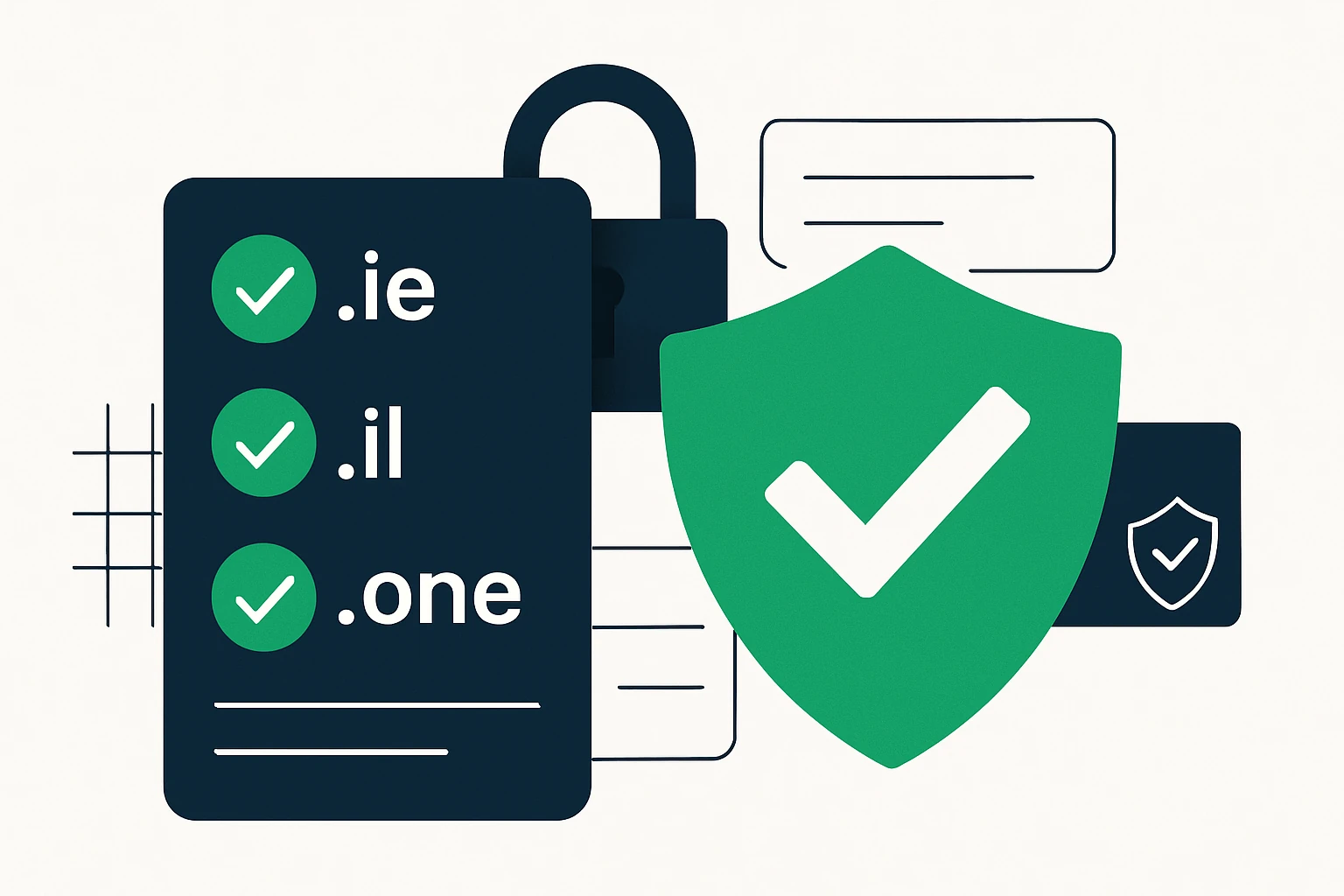
- Assess coverage: Confirm which TLDs are included (for example, .ie, .il, .one) and whether the data includes new registrations, renewals, and deleted domains.
- Check data format: Look for machine-readable formats (CSV/JSON) and fields that support enrichment (registrant country, registration date, status, etc.).
- Validate timeliness: Establish a cadence for updates (daily, hourly) and ensure there is a mechanism to surface newly registered domains quickly.
- Evaluate licensing: Read the license terms to see how you can store, process, and share data within your organization and with partners.
- Assess enrichment options: Determine whether you will pair domain lists with RDAP/Whois data, threat feeds, and brand-impersonation signals to improve confidence.
- Integrate with risk scoring: Map domain signals to risk scores (e.g., low/medium/high) and attach recommended actions (monitor, alert, or auto-takedown where policy allows).
- Pilot and measure: Run a controlled pilot to validate signal quality, false-positive rates, and the operational impact of responses.
As a practical note, many organizations adopt a two-tier approach: maintain a baseline dataset (for broad coverage) and augment it with real-time signals and user-reported abuse. This approach helps balance completeness with agility, which is critical in phishing defense and brand protection.
How NetzReporter brand protection fits into this picture
NetzReporter’s digital risk intelligence platform is designed to ingest domain signals alongside other external threat data, transforming raw lists into prioritized actions. The platform can harmonize data from multiple sources, including domain-lists by TLD, RDAP/WHOIS feeds, and traffic or abuse signals, to produce a unified risk view. This integration supports fast decision-making, automated incident response, and improved brand safety metrics. For teams evaluating or deploying domain-list data, the platform offers structured workflows, dashboards, and a playbook-oriented approach to reduce phishing exposure and protect customers. See how WebAtla positions its domain data and RDAP/WHOIS database offerings to support threat intelligence workflows: RDAP & WHOIS Database and List of domains by TLDs.
Client integration: where the data lives in the ecosystem
Practically, a defender would source domain lists from a provider, validate the data with RDAP/Whois sources where available, enrich it with contextual signals (brand-impersonation indicators, phishing infrastructure, etc.), and then feed it into a risk-scoring engine or incident-response workflow. NetzReporter can anchor this process by serving as the centralized platform that ingests domain lists, merges them with registration data, and triggers downstream actions such as alerts, takedown requests, or brand-protection desk tickets. The dual use of public-domain lists and private, license-based datasets helps balance breadth with reliability, enabling security teams to scale their monitoring without sacrificing precision. For readers who want to explore WebAtla’s data catalog and domain resources, two starting points are their RDAP & WHOIS database and the broader TLD lists page. RDAP & WHOIS Database | List of domains by TLDs.
Conclusion
Domain lists by TLD such as .ie, .il, and .one can be valuable components of a digital risk intelligence program, helping uncover potential threats early and guiding proactive brand-protection actions. However, data quality, timeliness, licensing, and integration with other intelligence feeds determine whether lists translate into measurable risk reduction. By combining standardized data access (RDAP), careful enrichment, and structured workflows, security teams can turn domain signals into concrete defenses - without conflating signals with certainty. As the threat landscape evolves, a disciplined, framework-driven approach to domain data will remain a core pillar of strong external threat monitoring and brand protection programs. For teams seeking to operationalize these signals at scale, the NetzReporter platform offers a structured path to ingest, enrich, and act on domain data within a broader risk-management workflow.